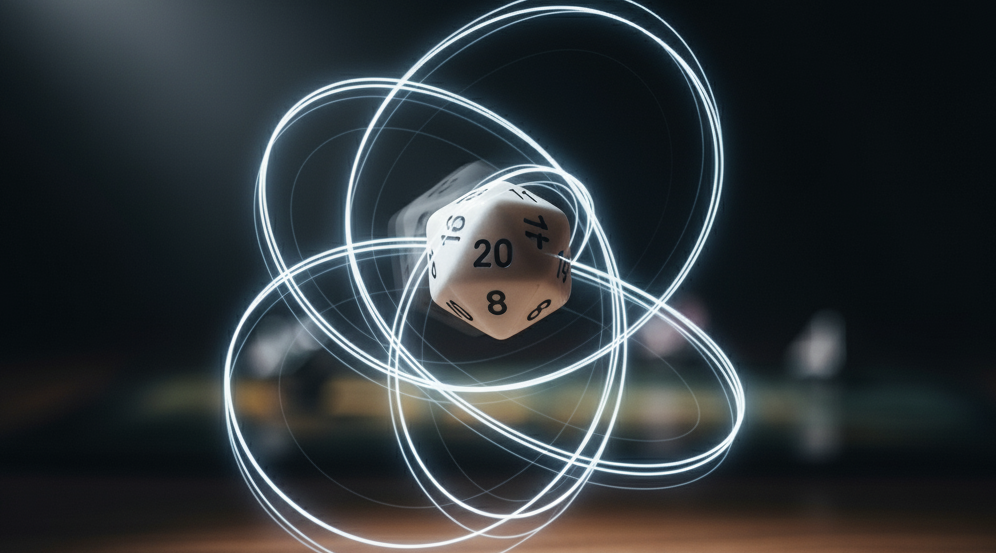
100

Ok, that was nice.

d20 Laurel

It took a while but I managed to get to the finish line. I kept my math degree “suspended” for quite too long but, finally, it’s here.

What a long strange trip it’s been…

Read more →

Learning habits

You don’t learn math: you get used to it

This was something my calculus teacher used to say and I really agree on that: it’s more about a slow burn.

Read more →

Integral of motions for RPGs

d20 test The concept of the integral of motion of a system is interesting. If you have something made of many interconnected parts that influence each other movements by impacts and/or forces of attraction and repulsion it’s a mess, BUT you can try to get off the mess by finding something that, despite of all interactions, stays pretty much the same.

In a more “physical” system, usually, total energy is a good candidate as something that does not change during whatever you are trying to model.

In other systems it could be something else but, since mathematics people are stubborn, it’s not unusual to still call it that way.

The concept of “something that stays the same during whatever is happening”, anyway, is called integral of motion and it’s usually a nice idea to find it if you want to study a system. And a Roleplaying Game ruleset is a system. So I did.

Wait, is it interesting?

No.

Because it’s data, and data, by itself, is boring.

Correlations in between data are far more interesting, because they try to point out that there can be something meaningful there and there actually is an interesting correlation. It’s taken from far away, it’s quite obvious and I need to double-check everything, but it’s quite there.

If you look at the various game systems, many of them have pretty specific integrals of motions wired in their system. They are usually constraints laid to limit the power that a single player has to intervene on the agency of other ones. More interestingly, many games do not have these constraints, but players put them in anyway. They serve a purpose: since the rules fix these limits, whatever bad things happen to the character comes straight from the rules and not from the player.

Take Daggerheart: the GM must spend Fear, an in-game currency, to make bad stuff happen, it’s capped, so the GM must spend it, and when it’s over some monsters cannot activate their worst abilities.

Take Band of Blades: the game has quite the structure, I played two full campaigns (both really enjoyable) but in both cases the GM put an extra structure on missions, turning them in the filling of three clocks, to match a three-act story structure that the game doesn’t have.

The interesting part is that there is a correlation in between how much structure a game has and how much successful it is. With some outliers, you can see that the less a game has a precise integral of motion, the more is played.

D&D, Call of Cthulhu, Vampire: the Masquerade, Pathfinder all of them do not really tell you “during a session you should follow this flow”: the flow is pretty much in the hand of one of the players* at the table and there is not really a limit on how much duress the party can meet. Nothing stops that player to say “ok, your newbie adventurers get out of the inn and they see the Tarrasque emerging from the ground, devastating the temple of the Five Thinders. Roll initiative” - and that is fine. I mean, when I said that it’s been the beginning of a great game night :)

Even removing D&D, which is an outlier per se, the correlation still stands. My gut response to this is that these systems stand on the trust players have on each other and, being built upon that, the final experience is improved.

That matches another thought of mine, that D&D books are not a game, but more of a framework that allows you to bring on the table your D&D.

I need more data and/or experiments to sustain or disprove the thesis. Everything in time.

[!Note] Footnotes! ( * ) Uh, I almost forgot this one. Yes, D&D’s 2024PHB uses player excluding the Dungeon Master, but that’s part of the lexicon. For the colloquial use of that term, the DM is still playing a game & is usually the one with some social duties, all delegable to others. So, yes, players, not capitalized nor italic, still includes the DM ;)

Read more →

Partial Derivative Equations

I’m getting ready for my last exams, then my thesis, then I’ll be off! It was a long time, I’m going to accomplish probably the biggest goal I let floating around for years because of ADHD - I’m pretty excited, the last rush is always the hardest but, in some way, I rewired myself to make me able to see the end of the line and it’s nice. To see the end of the line getting closer, I mean. And the subject I’m studying, of course, they relate to my favourite branch of maths: geometry and systems dynamics.

PDE

One of the two exams I’m getting ready for is about partial derivative equations (PDE):

  • take a space
  • take an item that defines any measures you want about each point in that space. Call the item $u$.
  • map how moving in one direction changes values in the item
  • link changes in one direction to changes in a different direction: “if I move two steps north and one east the values of $u$ stay the same”

and that is a PDO. Sort of. An easy one, that writes off something like

[u_N-2u_E=0]

“What’s the use for that?” - of course. Well, let’s say that instead of “North/South” and “East”, one of the directions can be “past/future”, “East/West” can refer to any positioning and the speed at which you have the changes can be called $c$ and not just 2: you get something like

[u_t-cu_x=0]

and you get an equation that represents something that moves in your direction with speed $c$. You can complicate a bit things: instead of saying how much you are moving into a direction, you can say at what rate you increase the speed in that direction. You end getting something like this

[u_{tt}-c^2u_{xx}=0]

that represents something in every direction with speed $c$. Like a lightwave. And if you say that in that space there is a source that produces light, then you get

[u_{tt}-c^2u_{xx}=f(x,t)]

with $f(x,t)$ an item, like $u$ that says that in a specific position $x$ at the time $t$ a lightwave is produced. You can also slow down a bit and try to match two different levels, like how does speed changes in time. Like if you are watching a drop of ink diffusing in a bowl of water - or heat diffusing into a body, or, reversing time, particles concentrating because subjected to gravity, you end up with something like

[u_t+D\nabla\cdot\nabla u=0]

with that triangle being the sum of variations in every direction. And, in the end? In the end the system reaches some sort of balance, where the variations of the system stay stable. So, variations of the variations are 0. Meaning

[\nabla\cdot\nabla u=0]

also written

[\Delta u=0]

with $\Delta$ being called Laplacian operator from Pierre Simon Laplace - interesting guy.

Laplace

Born from a wealthy family, he studied to become a priest, then he studied math and changed his mind. He asked for a letter of recommendation to be admitted to study with D’Alambert, a big name of the time. D’Alambert ignored the letter and him altogether. So Laplace sent him a 4 page essay about newtonian mechanics, to which D’Alambert replied something like “This is a good letter of recommendation, not the garbage you sent me before. Can you start on monday?” (Ok, probably not exactly these words, but that was the idea, pretty much. That’s more often than not why everyone is uncomfortable to work with mathematics but mathematics)

With D’Alambert (which, to be honest, was quite spot on on the second type of equations, so much that these equations are usually written as $\square u=0$ where that square $\square$ is called Dalembertian operator - but I’m digressing) Laplace discovered a lot about dynamic systems and wrote a lot about planets’ movement - he kind of set the standard on the study of dynamic systems, with Lagrange. He was quite the name. And he knew. And he didn’t make really a mystery of that, he thought he was the best french mathematician of his time. That leaves a mark on your reputation if you are not right and let’s just say it didn’t really leave a mark. At the time. Later on a bit, since he used his own status to take some results of other brilliant mathematicians as his own. I’m kinda sure about Fourier, I’ll check that out later.

Fun facts

Napoleon confronted him (Laplace had a job in his government court) saying that Newton referred to God multiple times in his writings while Laplace didn’t. Laplace answered that “he didn’t need that hypotesis”. That answer is still a point of discussion: for someone it frames him as an atheist, for others it frames him just as kind of a dick. I’m slightly more in agreement with the others :)

At his death they removed his brain and kept it in a jar for some time. And it was smaller than average. Maybe it’s a case of “It’s not about the size, it’s about how you use it”. Maybe it’s just a rumor from someone who Laplace pissed of. I mean, there was no scarcity of them.

Whatever. I’ll better go back to study!

Read more →

Is this working?

I’m studying for two exams. Both about calculus, one focuses on $\mathcal{L}^p$ spaces, Fourier series and transformations, the other one is about PDE, Partial Derivates Equations.

They are both super-interesting, my main problem is to study as a student after a quarter century of not-being a student. I’m finding easier to write pretty much a whole book about the subject in order to streamline and clean all the informations (and re-learn LaTeX code, which will be useful for the final thesis).

For example, I’m on the Heat Diffusion Equations, $u_t+D\Delta u=0$ and - wait, does this format correctly on the website?

Ouff. Let’s check it out…

Read more →